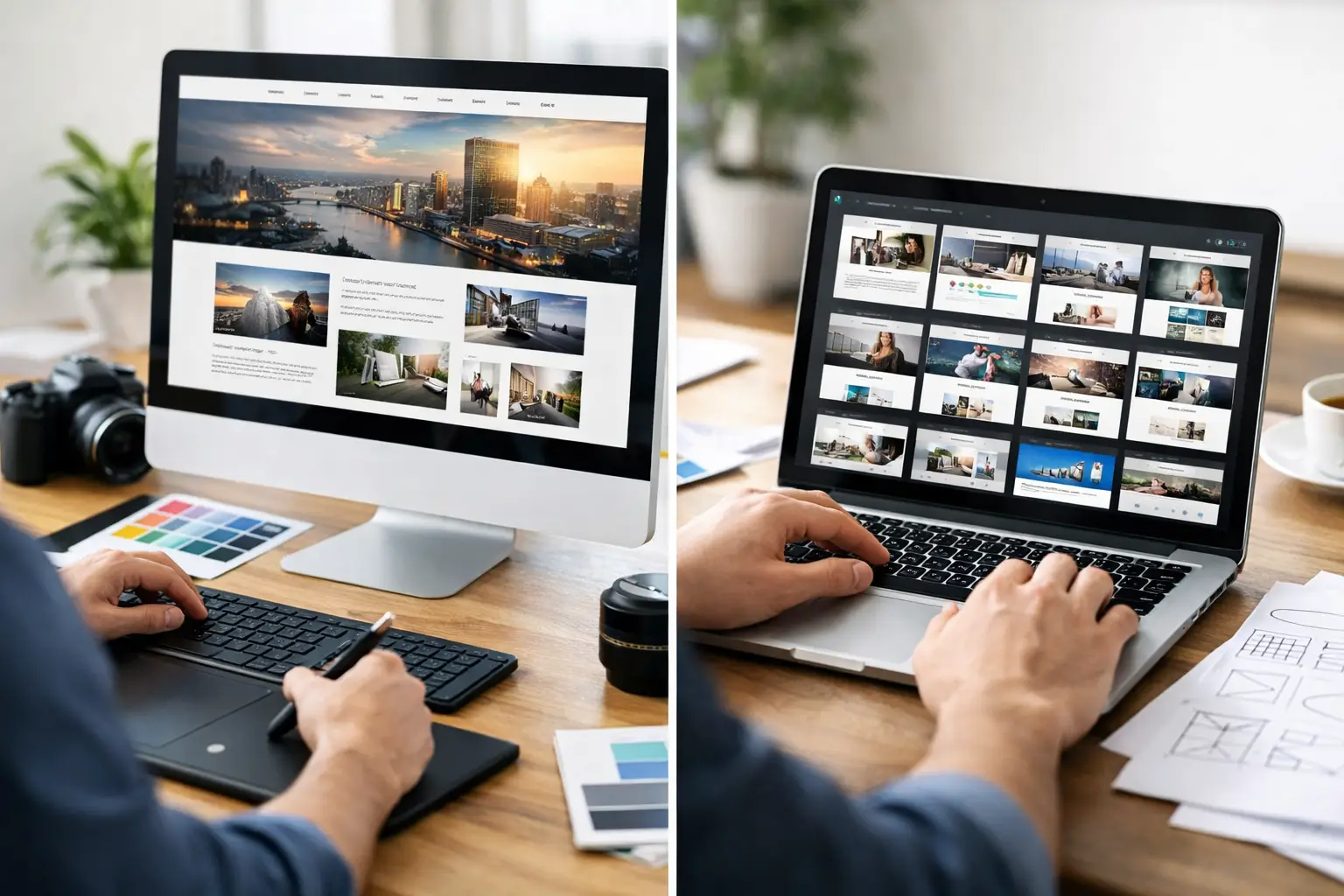
A website template can look like a smart bargain until it has to do real work for your business. The choice between custom websites versus templates is not simply about appearance or upfront cost. It affects how easily customers find you, how confidently they contact or buy from you, and how much time you spend working around your website instead of running your company.
For a new business with a simple offer, a well-chosen template may be enough to get online quickly. For an established business that relies on leads, local visibility, online sales, or a distinct professional reputation, a custom website often becomes the more practical investment. The right answer depends on what the website needs to accomplish over the next few years, not just what it costs this month.
What a Template Website Does Well
A template website starts with a pre-built design and a set structure for pages, headings, images, forms, and navigation. You add your logo, colors, copy, and photos, then adjust the available settings to make the site feel like your business.
This approach has real benefits. Templates are usually faster to launch, and the initial expense is lower than a fully custom build. If you are testing a business idea, promoting a short-term event, or creating a straightforward brochure site with only a few pages, speed may matter more than specialized functionality.
Many templates are also professionally designed at first glance. They tend to include mobile layouts, contact forms, image galleries, and basic page options. That can be a helpful starting point for a business that needs a credible online presence without a large initial commitment.
The limitation is that a template is designed to serve many types of businesses. A restaurant, contractor, accountant, retailer, and nonprofit may all begin with the same layout. As you add your specific services, sales process, location details, and calls to action, the compromises become more visible.
Where Templates Start to Cost More
The purchase price of a template does not tell the whole story. Many business owners discover later that the template requires paid add-ons, premium plugins, developer help, or ongoing workarounds to do what they expected from the beginning.
A common issue is page flexibility. Perhaps your home page needs a service-area section, before-and-after project photos, a quote request form, testimonials, financing information, and clear calls to action for mobile visitors. A template may technically allow all of that, but the result can become crowded, slow, or inconsistent as sections are forced into a layout that was not built for your priorities.
Templates can also create a maintenance burden. They often depend on several plugins and a theme framework, all of which must continue to work together after updates. When a plugin conflict breaks a form, changes a layout, or affects checkout, the savings from the original purchase can disappear quickly.
That does not mean every template is insecure or poorly built. It means the quality varies, and long-term dependability depends on how the site is assembled, updated, backed up, and monitored. A website that generates leads or sales should not be left unattended simply because it began as an affordable template.
Custom Websites Versus Templates: The Business Difference
A custom website is designed around your customer journey rather than around the limitations of a pre-made layout. Before design begins, the important questions are practical: What do customers need to know before they call? Which services bring the best leads? What proof helps them trust your business? What should happen after someone submits a form or places an order?
Those answers shape the navigation, page structure, content hierarchy, calls to action, and functionality. A home services company may need service pages built to support local search, project galleries that establish credibility, and quote forms that collect useful job details. A professional practice may need a clear explanation of its process, staff biographies, appointment requests, and a reassuring mobile experience. An online retailer may need product filtering, shipping rules, customer accounts, and a checkout process that does not create friction.
Custom does not have to mean excessive or complicated. It should mean intentional. The goal is not to add features because they are available. It is to build the parts that help your business attract, inform, and convert the right customers.
A tailored design also gives your business a stronger visual identity. Customers may not consciously recognize that a site uses a familiar template, but they do notice when the experience feels generic, confusing, or disconnected from the quality of the company behind it. For businesses competing across Nanaimo and Vancouver Island, a polished website can help level the field against larger competitors.
SEO Is More Than Adding Keywords
Both template and custom websites can rank in search results. Search engines do not automatically favor a custom design. What matters is whether the site provides useful content, clear organization, fast performance, a good mobile experience, and technically sound pages that search engines can understand.
The difference is control. A custom site can be planned around the pages your customers actually search for, including specific services, locations, product categories, and frequently asked questions. Its page templates can support clean heading structures, focused calls to action, optimized images, and internal organization that makes sense for your business.
With a template, SEO can still be effective, especially when the site is kept lean and thoughtfully organized. The trouble begins when unnecessary page builder code, oversized images, duplicate pages, or plugin overload slow the site down. A visually impressive demo can perform poorly once it is filled with real content.
Search visibility also needs ongoing attention. Publishing a site is the start of the work, not the finish line. Service offerings change, competitors update their content, and search behavior shifts. Whether your site is custom or template-based, it needs accurate information, useful content, and regular technical care.
How to Compare the Real Cost
A fair comparison looks beyond the first invoice. Consider the total cost over two to three years, including design, setup, premium licenses, maintenance, security, backups, updates, fixes, content changes, and future expansion.
A template may be the economical choice when your needs are stable and simple. If your website only needs to explain a limited service offering and provide a way to get in touch, the lower startup cost can be sensible. Choose a reputable theme, avoid excessive add-ons, and budget for maintenance from the outset.
A custom website generally costs more upfront because it includes planning, design decisions, development, testing, and a structure built around your business. However, it can reduce future rework when your site needs to add services, improve lead capture, support e-commerce, or strengthen local search visibility.
The key question is not, “Which option is cheapest?” Ask, “Which option gives us the best return with the least avoidable rework?” A low-cost website that fails to generate trust or creates ongoing technical problems is not necessarily a lower-cost business decision.
Choose a Template When Simplicity Is the Priority
A template is often appropriate if you need a basic site quickly, have a limited budget, offer a small number of services, and do not need unusual features. It can also work well for a temporary campaign, a new venture still being tested, or a business that has reliable internal help to manage content and updates.
The best template projects stay focused. Start with a small number of clear pages, use original photos and well-written copy, and resist adding every available widget. A simpler site that loads quickly and tells customers what to do next will usually outperform a cluttered one.
Choose a Custom Website When Growth Depends on It
Custom design makes more sense when the website is a central sales tool rather than a digital business card. That includes companies that depend on quote requests, appointments, online orders, service-area visibility, or a professional reputation in a competitive market.
It is also the stronger option when you have outgrown an existing website. Warning signs include a site that is difficult to update, poor mobile usability, inconsistent branding, low-quality leads, weak search performance, slow loading pages, or constant plugin issues. Rebuilding around a clear plan is often more productive than repeatedly patching an old template.
At Coastal Webmasters, we help business owners make this decision without pushing unnecessary complexity. Sometimes a refined template approach is enough. Other times, a custom build and ongoing WordPress care protect a more valuable part of the business: the steady flow of customers who need to find, trust, and contact you online.
Your website should make the next step easy for a customer and manageable for your team. If it is doing neither, the most useful next move is to define what the site needs to achieve before choosing the tool used to build it.